
The Needle Knows: How a Tiny Dutch Box Just Made the Laptop Optional Again
There's a specific kind of anxiety that lives in the muscle memory of anyone who has DJ'd with a laptop. It's the half-second glance down at a spinning wheel of death. It's the extra bag you carry just for cables, dongles, and a backup machine. It's the low hum of dread that your set could end not because you played a bad transition, but because macOS decided to run a security update mid-mix.
A note before we get into it: I haven't gotten my hands on a Devious Pocket yet, though I'd love to. What follows is built on a deep dive into the company's own documentation, independent hands-on coverage from other outlets, and a detailed video walkthrough of the unit in use, not my own time behind the decks with it.
A small Amsterdam-based outfit called NAP Works thinks it has found the exit ramp from that anxiety, and it looks almost nothing like what the DJ software giants have been selling for the past two decades. Their product is called the Devious Pocket, and its entire pitch can be boiled down to a sentence that would have sounded like science fiction in 2001, when digital vinyl systems first appeared: no laptop, no library software, no setup. Just a record, a USB stick, and a needle.
A Quarter-Century Detour, Finally Shortened
To understand why this matters, it helps to remember how DJs got here in the first place. Digital vinyl systems, or DVS, were born in 2001 with N2IT's Final Scratch, a piece of hardware and software that let a DJ control MP3 files using a specially timecoded record instead of a physical groove. It was a genuinely radical idea: keep the tactile ritual of vinyl DJing, but free the music itself from the limits of pressed wax. Stanton and Native Instruments eventually joined forces on the technology, which evolved into Traktor Scratch, while Rane and Serato built out Scratch Live and, later, Serato DJ Pro. Every version of that lineage, however, has shared one structural requirement: somewhere in the signal chain, there had to be a full computer, running full DJ software, translating the timecode into playback.
That requirement never really went away. It just got smaller and shinier. All-in-one controllers and CDJs eventually absorbed the laptop's job, but the fundamental idea, that digitized vinyl control requires a general-purpose computer running dedicated software, held for twenty-five years.
The Devious Pocket is the first serious attempt to fully sever that link at the hardware level rather than just hiding it inside a nicer box.
What's Actually Inside the Thing
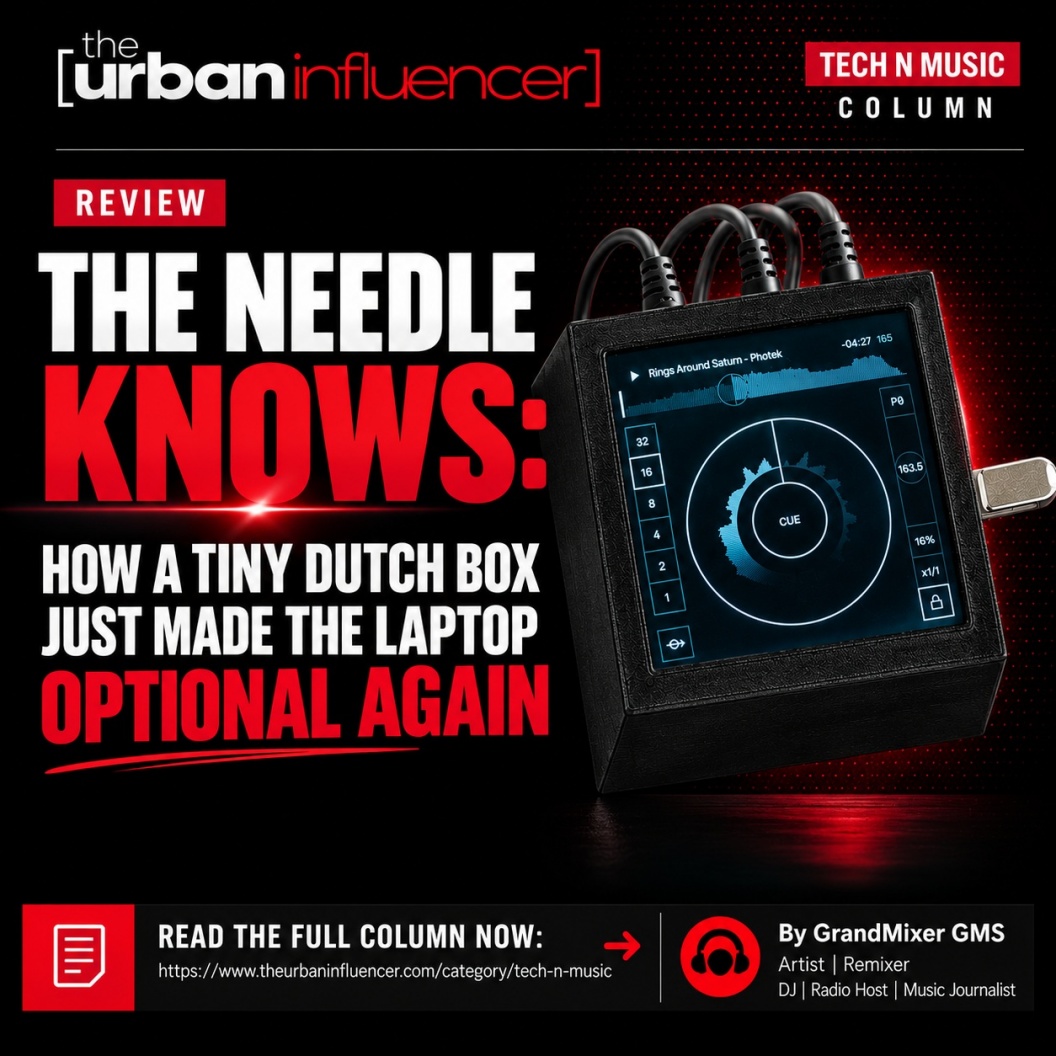
Strip away the branding and the Devious Pocket is a compact, passively cooled micro-computer, similar in spirit to a Raspberry Pi, paired with a HifiBerry digital-to-analog converter and wrapped in a 3D-printed shell with a four-inch touchscreen. It runs on NAP, an open-source real-time control framework that its creators originally built for large-scale interactive art installations, not nightclubs. Around back sit a USB-C power input, RCA outputs, a 3.5mm input for turntable signal, a gigabit Ethernet port that is present but not yet doing anything, and four USB ports split between USB 2 and USB 3 for reading music off a stick or drive.
Pricing sits in the neighborhood of $260 to $330 per unit depending on region and bundle, according to both NAP Works' own storefront and independent hands-on coverage, with modest discounts if you buy a pair or add cables and a stand. Because each turntable needs its own unit and the devices currently don't talk to each other, a two-deck DJ is looking at closer to $700 all in. That's still a fraction of the roughly $1,700-per-unit price of a flagship CDJ, and the company frames the low cost partly as a byproduct of an intentional design choice: no physical buttons, no dedicated controller hardware, just the touchscreen and the record itself as the instrument.
Audio quality has genuinely impressed early reviewers. The unit outputs a 48kHz/24-bit signal and upsamples anything lower, and its built-in digital phono preamp reportedly outperforms the underwhelming stock preamps found in some popular battle mixers, according to at least one detailed hands-on account. Format support covers MP3, FLAC, WAV, AIFF, CAF, and OGG, drawn from drives formatted in FAT32, exFAT, EXT4, or NTFS. Notably absent: AAC and Apple Lossless, a gap that will sting anyone whose library grew up inside iTunes.
Latency, the metric that has haunted every DVS product since Final Scratch, is where NAP Works makes its boldest claim. Because the touchscreen talks directly to the CPU instead of routing audio through USB frame packets, the company cites an internal processing latency of roughly two-thirds of a millisecond, a figure that, if it holds up under independent measurement, would put it ahead of most laptop-based rigs by a meaningful margin.
The Part Nobody Selling You a Product Wants to Admit
Here's where this column earns its keep, because the marketing copy and the accounts of DJs who've actually gotten their hands on one diverge in one important spot: the hybrid playback mode.
The Devious Pocket blends absolute mode, where the needle's physical position on the record maps directly to the position in the track, with relative mode, where the software mostly ignores needle position and instead tracks motion and cue points. On paper this sounds like the best of both worlds. In practice, according to detailed hands-on testing, it creates a real workflow problem the moment a DJ needs to lift the needle mid-track to clean dust or fluff off the stylus, something every working vinyl DJ eventually has to do. Drop the needle back down anywhere that isn't the exact spot it left, and the track jumps to wherever the needle physically landed, not where the mix was left hanging.
There is no full relative-only mode to dodge this yet, and the same testing found the transition zone near the end of a standard Serato control record, the part designed to trigger internal mode automatically, causes noticeably erratic behavior on the Devious Pocket. It's a solvable software problem, not a hardware limitation, but it is a real one for anyone who scratches or performs turntablism rather than simply beatmatching.
The bigger structural gap, though, is the absence of any library software. NAP Works treats this as a feature: drag files into folders on a USB stick, and the device reads ID3 tags to sort by artist, key, BPM, or genre, no proprietary crate manager required. For someone migrating off vinyl entirely, that's refreshingly uncomplicated. For anyone coming from Serato, Rekordbox, or Traktor, where playlists, crates, and play history are core muscle memory, it's a step backward that duplicate-file workarounds don't really fix. NAP Works has acknowledged in its own FAQ that Rekordbox tag support isn't currently on offer, framing the omission as a deliberate choice to avoid middleware rather than an oversight, though the company has left the door open to future changes.
Why This Is Bigger Than a Gear Review
Step back from the spec sheet and the Devious Pocket is really a bet on a behavioral pattern that the DJ industry has mostly ignored: a huge population of DJs who never left vinyl in the first place, and who have no interest in learning Serato or Traktor, but who occasionally want to drop one unreleased edit or one track they only have as a file. That audience has historically been told to either buy a full DVS rig with a laptop, or don't bother. The Devious Pocket is a bet that shrinking the entry cost and the cognitive overhead down to "plug in a USB and drop the needle" opens digital playback to DJs who would never otherwise touch it.
There's a second, quieter bet buried in the choice to build on an open-source framework and readymade, swappable components rather than a fully custom board. NAP Works has been explicit that the framework choice is partly philosophical, an attempt to keep the product repairable and reusable rather than disposable, in a hardware category, DJ gear, that has trended hard toward closed ecosystems controlled by a shrinking number of large manufacturers. Whether that philosophy scales past a crowdfunded first batch into something that can compete on features with companies with far deeper pockets is a genuinely open question, and probably the most interesting one this product raises.
Compatibility with Phase, the wireless DVS system that eliminates a physical timecode signal entirely, adds another wrinkle worth watching. Pairing the Devious Pocket with Phase in line-level mode reportedly resolves several of the unit's rougher edges, including pitch drift while scratching and sensitivity to vibration, while also letting a DJ keep their turntable's own phono preamp in the signal chain for pure vinyl. It's a glimpse of where this category could head: a world where the timecode itself goes fully wireless and the standalone box becomes the only piece of digital infrastructure a turntablist needs to carry.
The Bottom Line
The Devious Pocket doesn't beat Serato DJ Pro or Rekordbox on features, and it isn't trying to. It has no multiple cue points, no stem separation, no streaming integration, and no real music library to speak of. What it does is remove an entire category of friction, and arguably an entire category of anxiety, for a specific kind of DJ: the one who already owns turntables, already thinks in vinyl, and just wants an occasional digital track without carrying a laptop into the booth. For that person, the reporting and testing so far suggest this is close to the cleanest solution the format has produced.
For everyone else, the honest read is to watch this space rather than write it off. A device built on an open framework, shipped by a small team that appears to be iterating quickly and openly documenting its own limitations, has more room to grow into its promise than most closed hardware ever gets. The needle, it turns out, might still have some tricks left to teach the industry.
What do you think? Is a laptop-free future actually where turntablism is headed, or is this destined to stay a niche tool for vinyl loyalists? Drop your take in the comments, and if you've used DVS in any of its previous lives, Final Scratch, Traktor Scratch, Serato, we want to hear how the Devious Pocket stacks up.
Sources and Further Reading
NAP Works, official Devious Pocket product page: https://nap.works/
NAP Works, Devious Pocket technical documentation: https://docs.nap.works
NAP Works, Devious Pocket storefront and pricing:
https://shop.nap-labs.tech/products/devious-pocket-standalone-dvs
DJ TechTools, "Devious Pocket: a €249 open-source DVS that ditches the laptop":
https://djtechtools.com/2026/05/10/devious-pocket-a-e249-open-source-dvs-that-ditches-the-laptop/
CDM (Create Digital Music), "Devious Pocket: standalone, simple digital vinyl from any turntable":
https://cdm.link/devious-pocket-standalone-simple-digital-vinyl-from-any-turntable/
Gearnews, "NAP Works Devious Pocket Is a Standalone DVS Device - No More Laptops?":
https://www.gearnews.com/nap-works-devious-pocket-dj/
Gearnews, "DVS and DJing: Everything You Need to Know About Digital Vinyl Systems":
https://www.gearnews.com/dvs-and-djing/
Indiegogo, Devious Pocket campaign page and updates:
https://www.indiegogo.com/en/projects/nap/devious-pocket
Wikipedia, "Digital vinyl system" (Vinyl emulation):
https://en.wikipedia.org/wiki/Vinyl_emulation
DJ City / Beatport Tech, hands-on video review transcript of the Devious Pocket (source material provided for this column)
https://youtu.be/xncZ3891SQU?si=3XochTrpEirhJoRa
Tech N Music | The Urban Influencer
Digital Vinyl Systems, DVS Technology, Turntablism, Vinyl DJing, Laptop‑Free DJing, DJ Gear Innovation, Open‑Source DJ Tech, Real‑Time Audio Processing, DJ Latency Performance, Timecode Vinyl, Devious Pocket, NAP Works, Raspberry Pi DJ Tech, HifiBerry DAC, Standalone DVS, Phase Wireless DVS, Serato Control Vinyl, Traktor Scratch, Final Scratch, Music Technology, DJ Technology Trends, Audio Engineering, Digital Music Tools, Music Hardware Innovation, Open‑Source Audio Frameworks, Real‑Time Control Systems, Turntable Culture, DJ Performance Tools, Scratch DJing, Battle DJ Gear, Vinyl Loyalists, DJ Workflow, Club DJ Technology, Standalone DJ Systems, Laptop‑Free DJ Workflow, DJ Latency Benchmarks, Digital Vinyl Latency, DJ Library Management, Rekordbox Alternatives, Serato Alternatives, Open‑Source DJ Platforms, DJ Gear Repairability, Modular DJ Hardware, Tech N Music, Music Industry Analysis, DJ Gear Reviews, Digital Music Trends, Music Technology Commentary, DJ Culture Editorial