
The Bot That Almost Beat Olivia Rodrigo: Why TIDAL's AI Music Crackdown Only Solves 19% of the Problem
On April 17, 2026, the number one song in America wasn't sung by anyone.
"Celebrate Me," credited to an R&B artist named IngaRose, sat atop the U.S. and global iTunes charts — a persona with an Apple Music page, 228,000 Instagram followers, and an Instagram bio that quietly admitted the trick: human-written lyrics, run through the AI generator Suno. Five of that week's iTunes Top 100 belonged to her. By nightfall, Olivia Rodrigo's "drop dead" had knocked her back down to earth.
It was a strange, fitting snapshot of where music stands right now — a machine-assisted persona and a 23-year-old pop star trading the same chart position on the same day, and almost nobody could say with certainty why one deserved to be there more than the other. That collision is the real subject of TIDAL's new AI policy, even if the press release doesn't say so directly.
What TIDAL Actually Did
On June 29, TIDAL announced that fully AI-generated tracks will no longer earn royalties or qualify for direct-to-fan sales on the platform, effective July 15. Songs the service identifies as 100% machine-made will carry a visible tag. Content that impersonates a real artist, or that shows signs of fraudulent streaming activity, can be blocked or removed outright.
TIDAL executive Tony Gervino framed it as a defense of what he called organic creativity, not a rejection of the technology itself — the goal, he wrote, was protecting artists' ability to build real relationships with fans, since many listeners had told the company they didn't want AI music pushed into their recommendations. He was careful to note the policy remains a living document, open to revision as the technology — and the law — catches up.
That distinction matters more than the headlines about a "crackdown" suggest. TIDAL isn't banning AI-made music. Read the actual policy, and the company explicitly says artists should have the freedom to create with AI tools and listeners the freedom to choose them. What TIDAL is doing is narrower and more targeted: it's refusing to pay out on content it defines as wholly AI-generated, while leaving the door open, deliberately, on everything short of that.
Which is where this gets interesting.
Everyone Else Already Drew a Line — Just Not the Same One
TIDAL isn't first. It's the fourth or fifth major platform to formalize an AI policy in the last year, and the industry's approaches now sit on a real spectrum rather than a single standard.
Deezer moved first and hit hardest. Since June 2025 it has tagged AI content platform-wide, stripped it from algorithmic recommendations and editorial playlists, and this spring stopped even storing hi-res versions of AI files. Apple Music took the opposite approach in March, placing the burden of disclosure on labels and distributors through a "Transparency Tags" system rather than detecting content itself. Spotify has leaned on the DDEX industry standard for AI-related credit disclosures. Qobuz began tagging AI uploads in February. TIDAL's demonetization-without-removal model is its own middle path — content stays up, listeners get a badge, the money simply stops.
The scale of what all of this is responding to is what makes the policies feel less like housekeeping and more like triage. Deezer now receives close to 75,000 fully AI-generated tracks every single day — 44% of everything uploaded to the platform, up from roughly 10,000 a day just eighteen months earlier. That's over two million synthetic tracks a month arriving at one mid-sized streaming service alone.
And yet — this is the detail that should stop anyone reading past it — actual listening to that flood remains tiny. Deezer puts AI music at just 1% to 3% of total streams. Of that sliver, the company says 85% is fraudulent: bots streaming bot-made songs to siphon fractions of a cent from a shared royalty pool, with essentially no human ear anywhere in the loop.
The Part the Headlines Are Missing
Here's the thing nobody covering TIDAL's announcement seems to be asking: how much of the actual problem does a "wholly AI-generated" cutoff even reach?
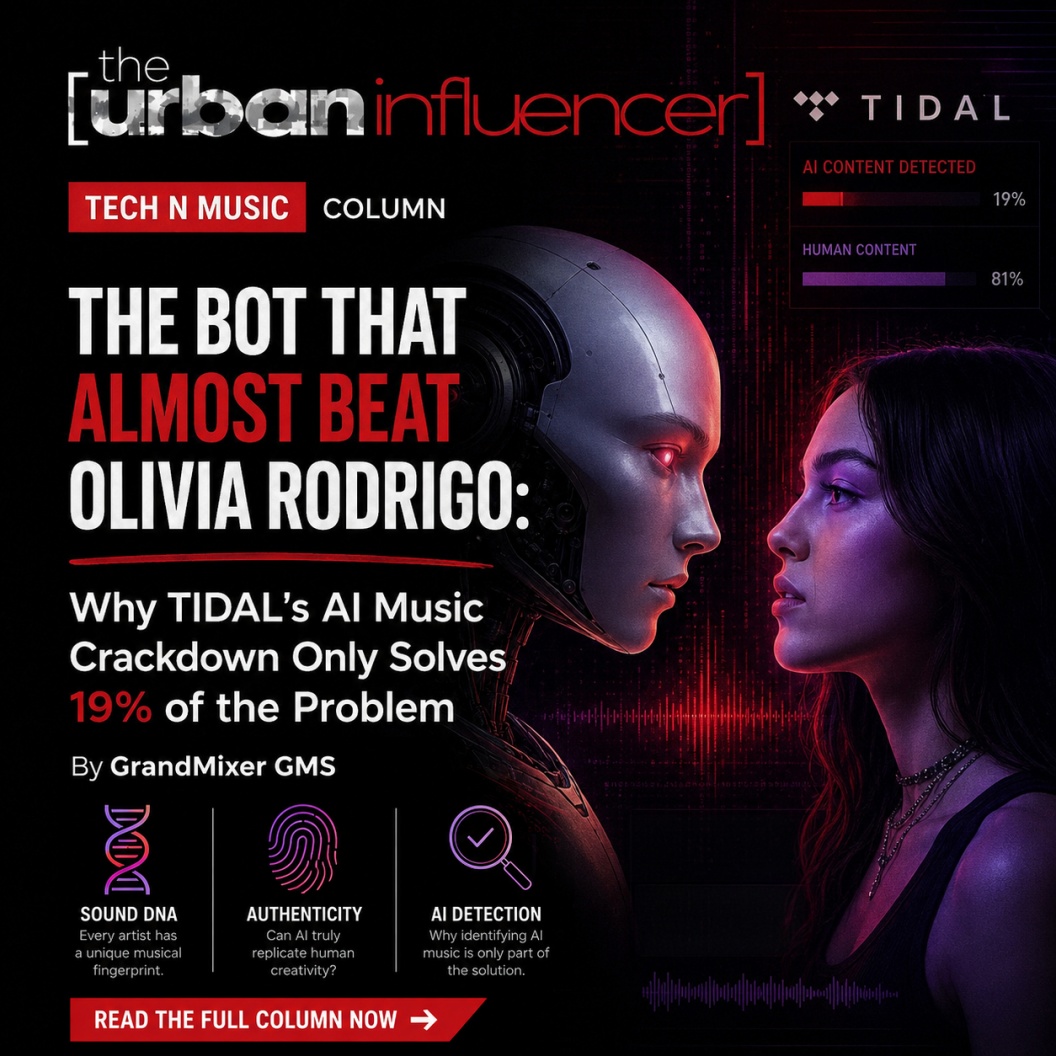
Not as much as it sounds like. SIQA, an outfit that launched a dedicated AI Music Top 100 chart earlier this year, broke down what's actually landing in its submissions pipeline: only 19% of the AI-touched tracks it sees are fully AI-generated from start to finish — the category TIDAL, Deezer, and everyone else are writing policy around. Another 48% are AI-assisted, meaning a human is still driving the creative decisions with AI filling in production gaps. The remaining third are hybrids where an artist uses AI specifically to clone or extend their own voice.
IngaRose's "Celebrate Me" is the case study. It isn't presented as wholly synthetic — the artist's own bio says the lyrics are human-written, only the vocal stems and arrangement were run through Suno. Under TIDAL's definition, and under most of the industry's current thresholds, that kind of track likely keeps earning. Xania Monet, the AI-voiced persona created by songwriter Telisha "Nikki" Jones that became the first synthetic act on a Billboard airplay chart, sits in the same gray zone — a real writer, a manufactured voice, full monetization eligibility.
That's not a loophole TIDAL forgot to close. It's a line the company drew on purpose, because the alternative — trying to police degree of AI involvement rather than its total presence — is close to unenforceable with the tools available today. But it does mean the policy, as written, addresses maybe a fifth of what's actually flowing through the pipes. The other 81% sails through with a T-shirt that says "assisted," not "generated."
None of this is really about the streaming royalty a hybrid track earns, either, if you follow where the money in these campaigns actually flows. IngaRose's business isn't Spotify's or TIDAL's per-stream rate — it's 300,000 TikTok videos, a quarter-million Instagram followers, and a brand ready to be licensed, endorsed, or sold to a real label as a going concern. Streaming royalties are almost a rounding error next to that. A demonetization policy that only touches the payout layer doesn't touch the business model at all.
Why 97% of Us Can't Tell — and Don't Care That We Can't
There's a psychological wrinkle here that the policy fights tend to skip past, and it's the most interesting part of the whole story.
Deezer ran a blind listening survey last fall and found that 97% of participants could not reliably tell AI-generated music apart from human-made music. That's a striking number on its own. What's more striking is what the same survey found right next to it: 80% of those same listeners still wanted AI music clearly labeled, and just over half didn't think fully synthetic songs belonged on the same charts as human ones.
Put those two findings together and you get something that cuts against the usual assumption in this debate — that transparency labels exist to help people detect a flaw in the audio. They don't, mostly, because most people can't hear one. What the labels actually protect is something closer to informed consent about who you're forming a connection with. Fandom has never really been a purely acoustic experience. It's parasocial — built on the sense that a specific, knowable person wrote this line about heartbreak because they lived it. Take away the person and the sound can be indistinguishable, but the relationship changes anyway, the way finding out a heartfelt letter was written by committee changes how it reads even if not a word is different. That's a values question, not a hearing test, and no detection algorithm — no matter how good it gets — was ever going to resolve it.
That also explains why demonetization, on its own, was never going to be a complete fix. If the objection is fundamentally about consent and disclosure rather than audio quality, then the fix has to be labeling and provenance — which is exactly the tool every platform, including TIDAL, has reached for alongside the money question.
What's Actually Coming Next
Platform policy is the visible layer. Underneath it, two bigger shifts are moving faster than most listeners realize.
The first is legislative. The NO FAKES Act — a bipartisan bill creating the first federal property right over a person's voice and likeness against unauthorized AI replication — cleared the Senate Judiciary Committee by unanimous voice vote on June 18, with backing from the RIAA, the AFL-CIO, and, notably, OpenAI itself. It's not law yet; it still needs a full Senate vote and House reconciliation. But it would put real teeth behind the "impersonation" half of TIDAL's policy — the part about blocking AI music that steals a specific artist's identity — in a way platform terms of service alone can't. Expect streaming AI policies to get rewritten again the moment this passes, because right now they're largely voluntary commitments filling a gap federal law hasn't closed.
The second shift is economic, and it's the one the industry is quietly most afraid of. A widely cited study from the songwriter collecting-society group CISAC estimates that generative AI could put roughly a quarter of music creators' revenue at risk by 2028 — not primarily through fraud, but through straightforward substitution, as AI-generated tracks fill the low-stakes, high-volume corners of the market: mood playlists, background music, algorithmic radio. Demonetizing wholly-AI tracks doesn't touch that pressure at all, because the threat isn't bot fraud stealing pennies — it's AI music becoming good enough and cheap enough that it displaces commissioned human work in exactly the places most people never consciously notice they're listening to music.
Where does that leave a policy like TIDAL's? Probably as a first draft, not a solution — and TIDAL essentially admits as much by calling it a living document. The more durable framework the industry is edging toward, deal by deal, isn't a binary of "human" versus "AI." It's tiered consent: did the artist whose voice or style is being used agree to it, and are they being paid for it. Suno's licensing partnership with Timbaland points one direction — AI as an instrument a human artist chooses to play, credited and compensated like any other collaborator. IngaRose points the other — AI as a persona built to game a discovery system with no consent chain to trace at all. Right now, TIDAL's rule can't tell those two things apart any better than the rest of us can by ear. Eventually, provenance data probably will — and that, not the demonetization headline, is the policy fight actually worth watching over the next eighteen months.
The IngaRose story ended, for now, with a real artist knocking a synthetic one off the top of the chart. That won't always be the outcome. But it's a useful reminder that the fight was never really human versus machine — it's disclosure versus deception, and consent versus its absence. TIDAL just made the first one slightly more expensive to skip. The second one is still wide open.
Sources and Further Reading
TechCrunch, "TIDAL cracks down on AI music by cutting off monetization," June 29, 2026
https://techcrunch.com/2026/06/29/tidal-cracks-down-on-ai-music-by-cutting-off-monetization/
TIDAL, official AI Policy page, June 29, 2026
https://tidal.com/ai-policy
TechCrunch, "Deezer says 44% of songs uploaded to its platform daily are AI-generated," April 20, 2026
https://techcrunch.com/2026/04/20/deezer-says-44-of-songs-uploaded-to-its-platform-daily-are-ai-generated/
Deezer Newsroom, "AI-generated tracks now represent 44% of all new uploaded music," April 20, 2026
https://newsroom-deezer.com/2026/04/ai-generated-tracks-represent-44-of-new-uploaded-music/
Music Business Worldwide, "75,000 AI-generated tracks now flood Deezer daily," April 20, 2026
https://www.musicbusinessworldwide.com/75000-ai-generated-tracks-now-flood-deezer-daily-representing-44-of-all-new-music-uploaded-to-the-platform-says-streamer/
Music Ally, "Deezer says that AI-generated tracks are now 44% of its uploads," April 21, 2026
https://musically.com/2026/04/21/deezer-says-that-ai-generated-tracks-are-now-44-of-its-uploads/
Forbes, "The No. 1 Song On U.S. iTunes—And Several Other Countries—Is AI Generated," April 17, 2026 https://www.forbes.com/sites/conormurray/2026/04/17/the-no-1-song-on-us-itunes-and-several-other-countries-is-ai-generated/
Forbes, "Olivia Rodrigo's New Song Dethroned An AI-Generated Track From No. 1," April 18, 2026 https://www.forbes.com/sites/hannahabraham/2026/04/18/olivia-rodrigos-new-song-dethroned-an-ai-generated-track-from-no-1/
Dexerto, "AI generated song takes #1 spot on iTunes global charts," April 17, 2026
https://www.dexerto.com/entertainment/ai-generated-song-takes-1-spot-on-itunes-global-charts-3353485/
Newsweek, "New Singer Dominating iTunes Chart Is AI-Generated," April 7, 2026
https://www.newsweek.com/new-singer-dominating-itunes-chart-is-ai-generated-11791886
One More Shot AI Blog, "AI Artists Are Topping the Charts in 2026," April 22, 2026
https://www.onemoreshot.ai/blog/ai-artists-are-topping-the-charts-in-2026/
CISAC, "Global economic study shows human creators' future at risk from generative AI," December 4, 2024
https://www.cisac.org/Newsroom/news-releases/global-economic-study-shows-human-creators-future-risk-generative-ai
CISAC / PMP Strategy AI Study (full report landing page)
https://www.cisac.org/services/reports-and-research/cisacpmp-strategy-ai-study
Music Business Worldwide, "Market for Gen AI outputs to be worth over $16bn annually by 2028... CISAC predicts," December 4, 2024
https://www.musicbusinessworldwide.com/market-for-gen-ai-outputs-to-be-worth-over-16bn-annually-by-2028-but-it-could-cannibalize-24-of-music-creators-revenues-cisac-predicts/
Holland & Knight, "Senate Committee Advances Bill to Protect Name, Image, Likeness and Voice Against Unauthorized AI Use," June 2026
https://www.hklaw.com/en/insights/publications/2026/06/senate-judiciary-committee-advances-legislation-to-protect-name
Washington Times, "Senate panel advances bill to protect against unauthorized AI copies of voice or likeness," June 18, 2026
https://www.washingtontimes.com/news/2026/jun/18/senate-panel-advances-bill-protect-unauthorized-ai-copies-voice/
Rep. Maria Salazar, "Senate Judiciary Committee Advances Out of Senate Judiciary Committee with Unanimous Support," June 2026
https://salazar.house.gov/media/press-releases/rep-salazars-no-fakes-act-advances-out-senate-judiciary-committee-unanimous
Tech N Music | The Urban Influencer
AI Music, TIDAL AI Policy, Streaming Industry News, Music Technology, Generative AI, AI‑Generated Songs, Music Monetization, Digital Music Rights, Streaming Fraud, IngaRose, Olivia Rodrigo, Suno AI, Xania Monet, Telisha Nikki Jones, NO FAKES Act, Voice Likeness Protection, AI Copyright Law, Artist Consent, Music Licensing, CISAC AI Study, Music Creator Revenue, AI Market Growth, Background Music AI, Mood Playlist AI, Deezer AI Policy, Apple Music Transparency Tags, Spotify AI Disclosure, Qobuz AI Tagging, AI Music Detection, Listener Preferences, Parasocial Fandom, Music Transparency Labels, Tech N Music, Music Industry Analysis, Streaming Policy, AI in Hip‑Hop, Digital Music Trends, Synthetic Artists, Hybrid Music Production, AI Voice Cloning, Music Provenance Data, AI Chart Rankings